

The intelligence layer for materials science.
Polaron helps materials teams turn microstructure into an objective, scalable input for decisions - reducing uncertainty, accelerating design cycles, and unlocking better performance.
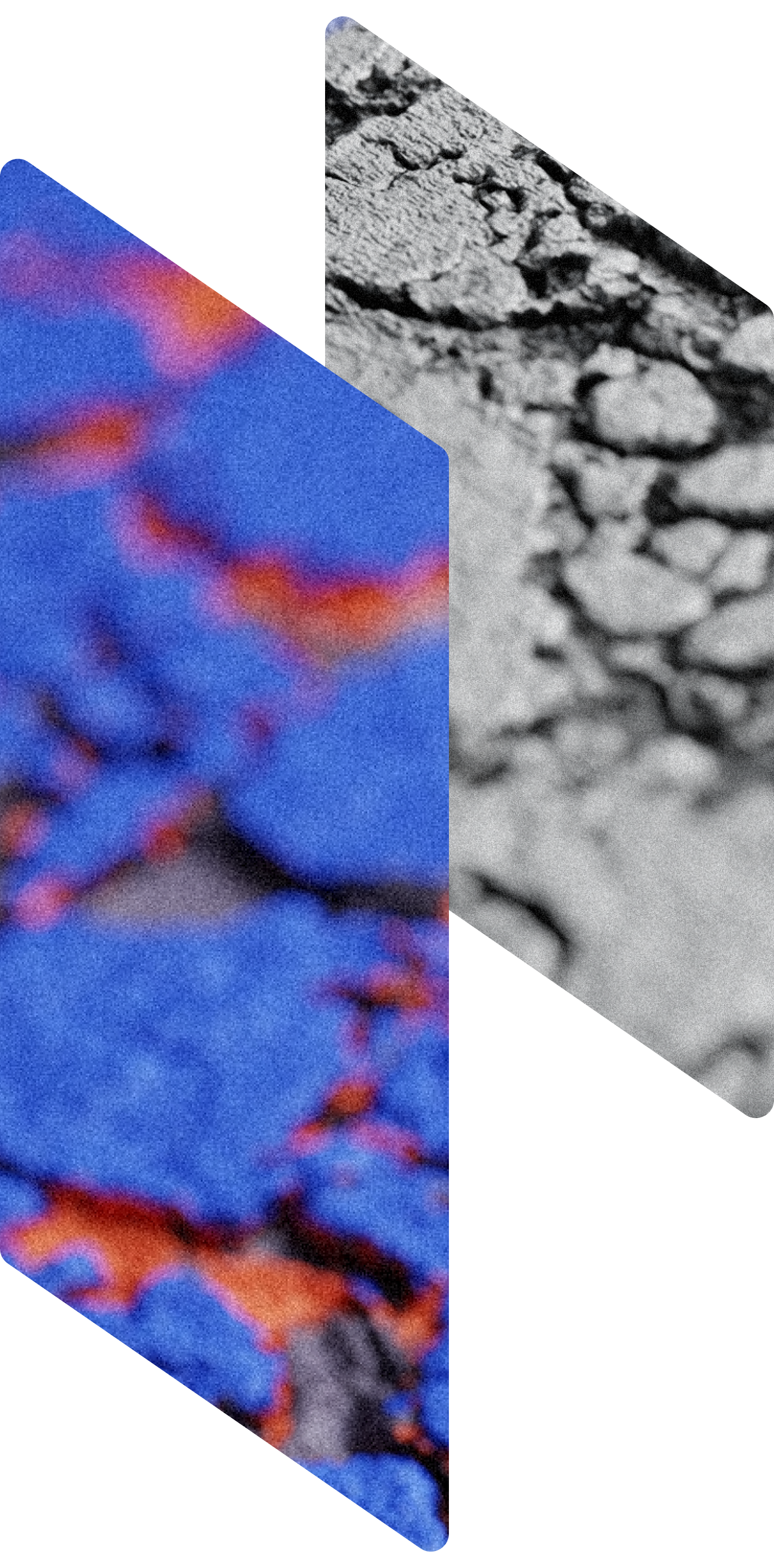
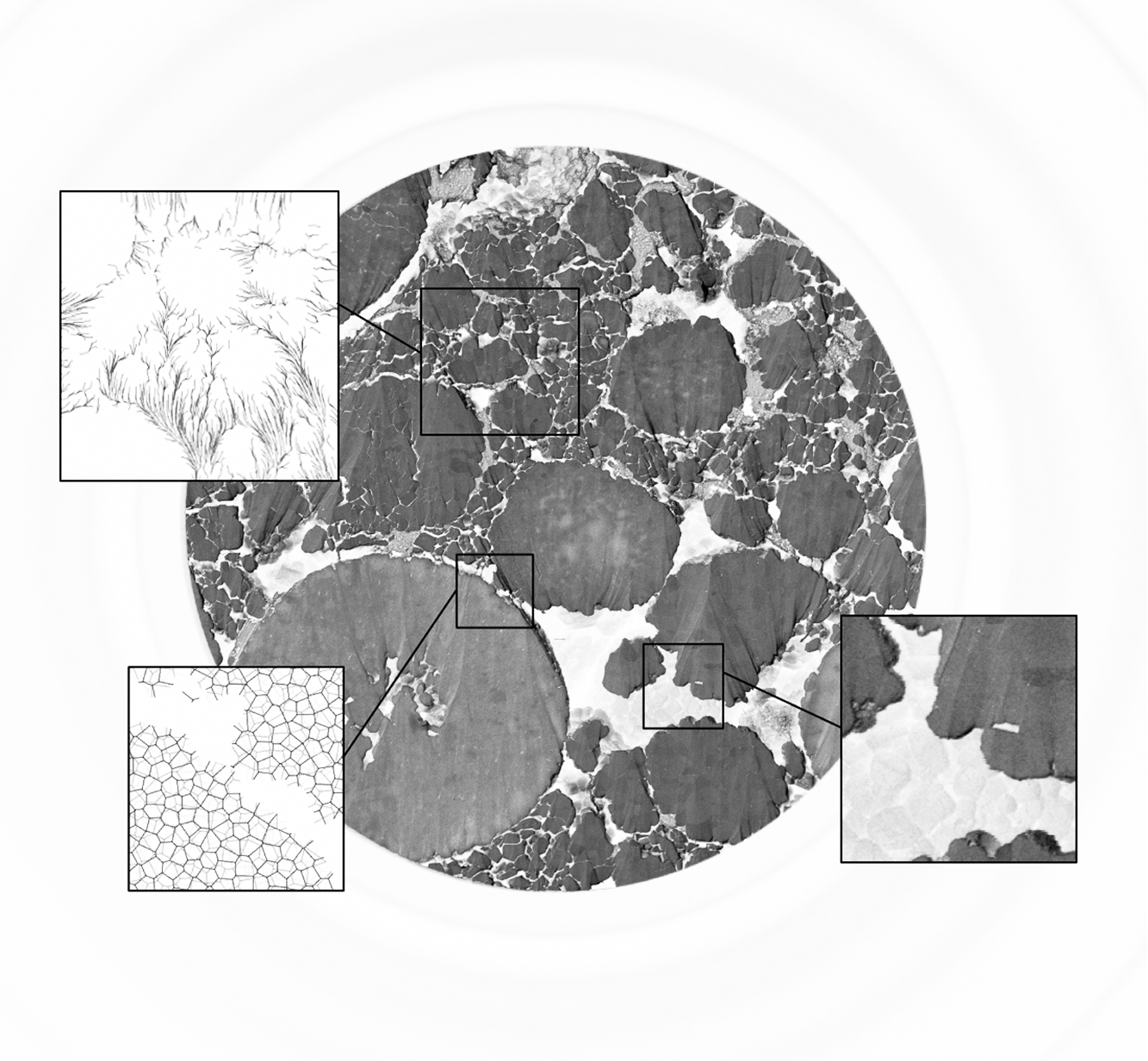
Microstructure dictates performance. Current workflows don’t capture it.
Microstructure dictates performance.
Performance, reliability, yield, and lifetime are all shaped by microstructure. This is why every lab in the world has microscopes.
But current workflows are not capturing it.
Teams already generate huge amounts of microstructural data. But most of that data is still interpreted manually, partially, or inconsistently.
This introduces risk and bottlenecks innovation.
Critical engineering decisions rely on incomplete insight, slowing development, increasing iteration cycles, and leaving performance on the table.
We build AI models to characterise and design microstructure better than ever before.
Purpose-built AI models for microstructure workflows.
Covering segmentation, quantitative analysis, 3D reconstruction, and design.
Characterisation at a new level of fidelity.
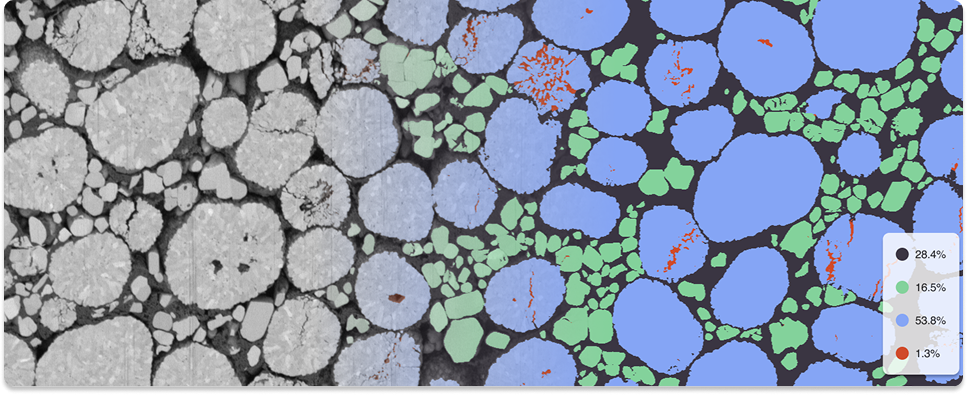
Automate the measurement of features, phases, and defects through Polaron Segmentation with accuracy that matches or exceeds expert analysis. Unlock 3D insights at the speed and resolution of 2D imaging through Polaron Reconstruction.
Move from observing microstructure to designing it.
Use microstructure as a controllable variable. Explore how process and material choices shift microstructure, and what that means for performance with Polaron Design - enabling faster, evidence-driven decisions at every stage.

Microstructure intelligence to reduce risk, accelerate decisions, and unlock performance.
More certainty with standardised, objective evidence.
Polaron makes microstructure measurable and comparable - replacing subjectivity with reproducible evidence that teams can trust across people, sites, and time.
Move faster from data to decision.
Polaron compresses the time across R&D, quality, and modelling workflows - with less manual work, faster engineering loops, and rapid identification of what changed and what matters.
Unlock performance with microstructure as a variable.
Polaron enables data-driven design of microstructure - so teams can compare trade-offs more systematically and optimise process and design parameters directly.
The models to measure, understand, and design microstructure.

Identify and quantify the features that matter in microscopy data - turning complex microstructure into consistent, objective measurements you can trust and compare.
From 2D images to 3D volumes. Unlock deeper insights into critical properties such as transport, mechanics for deeper understanding and better downstream modelling.
Use microstructure-derived data to explore microstructural design scenarios and guide optimisation - connect process to structure, and structure to outcomes. Helping teams make better design trade-offs and reduce experimental iterations.
Deployed through a secure enterprise platform, backed by experts.
Enterprise-ready, secure-by-design.
Built for robust, repeatable operation across teams, sites, and secure environments - meeting enterprise security and compliance requirements at scale.
Collaborative and traceable.
Outputs are structured, shareable, and reusable - with full traceability from image data to decision, reducing friction across R&D, quality, and modelling stakeholders.
Customisable workflows, expert supported.
Configurable to match how your organisation works - with Polaron's materials and AI experts on hand to support onboarding, model configuration, and workflow design from day one.

Read our latest case study here.
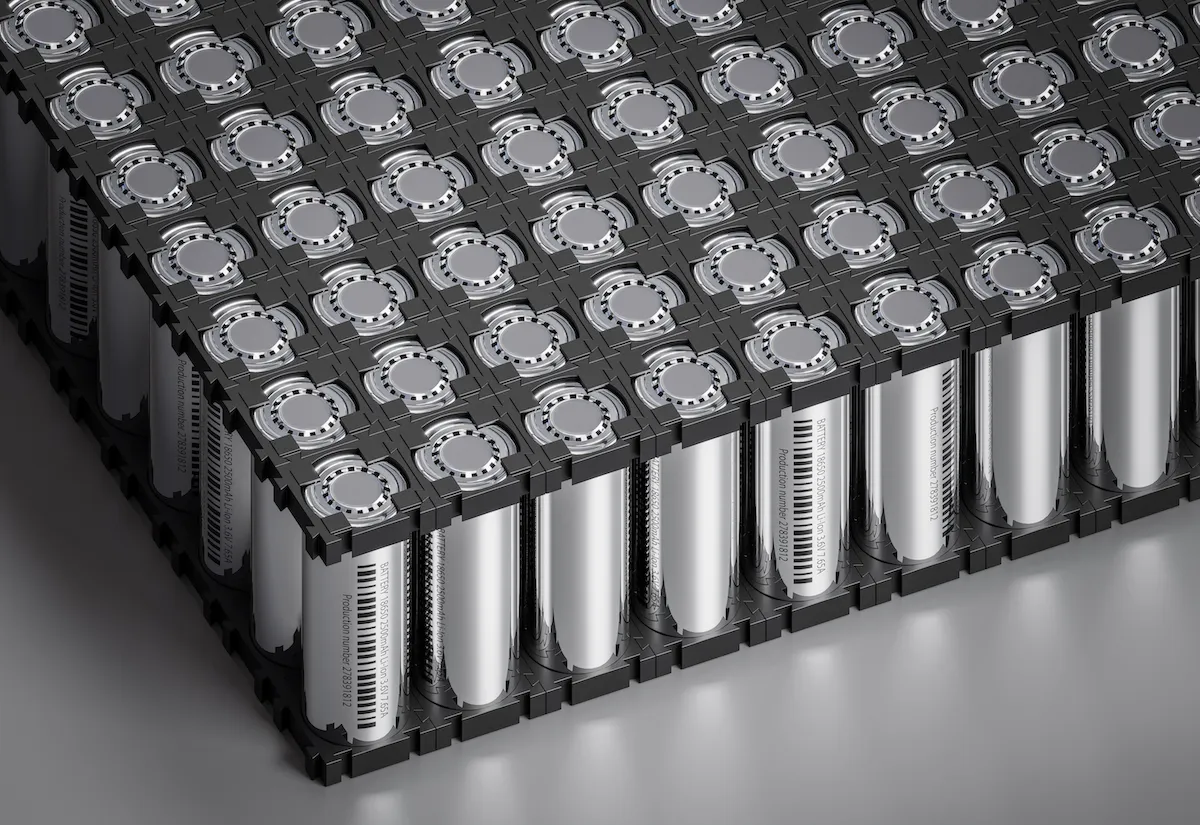
Polaron has been supporting leading automotive OEMs to quantify electrode level degradation.
Applications
Polaron is used by engineering teams to reduce risk, speed up learning cycles, and unlock performance. Explore how different teams are applying Polaron in their workflows.

Increase confidence. Shorten cycles. Design in-silico.
Automated microstructure quantification, at scale.
Segment phases and features (e.g., pores, cracks, particles, interfaces) to produce consistent metrics such as size distributions, volume fractions, morphology descriptors, and defect statistics - across large datasets, and across 2D and 3D.
Root-cause and change analysis between conditions.
Compare microstructure distributions across process/material variants to pinpoint what changed (and by how much), supporting faster hypothesis testing and tighter iteration loops.
Move design in-silico.
Use Polaron’s models to explore how design parameters and process conditions shift the resulting microstructure, and what that means for performance and reliability. This enables teams to virtually screen thousands of variations and narrow to the most promising regions before committing to additional experiments, drastically reducing the time and number of experimental iterations needed to reach targets.

Standardise evidence. Detect drift early. Make decisions faster.
Objective acceptance criteria from microstructure metrics.
Define quantitative metrics based on measured feature distributions (e.g., defect density, spatial heterogeneity, changes in porosity), reducing dependence on subjective interpretation and individual expert judgement.
Drift detection and batch-to-batch comparability
Track microstructure distributions over time and across sites/suppliers to detect subtle shifts early, enabling faster containment actions before issues compound into downtime or field risk.
Traceable evidence for cross-team alignment.
Generate consistent, auditable outputs that reduce friction between lab, production, supplier, and leadership stakeholders - so decisions don’t stall.

Better parameters in. More predictive models out.
Microstructure-derived parameterisation for physics-based models.
Derive modelling-ready descriptors from segmentation and reconstruction (e.g., phase fractions, transport properties, interfacial surface areas) to improve predictive power of models.
Reduced parameterisation burden via microstructure-grounded inputs.
Decrease reliance on ad-hoc fitting and complex, unclear experiments by grounding assumptions in repeatable, image based workflow. Supporting more defensible models and faster iteration when exploring process/material changes.
Predictive models for process, structure, performance.
Build predictive models that connect process conditions to microstructure and ultimately to performance outcomes - so teams can forecast how changes in processing are likely to shift structure and impact KPIs, and then prioritise the most valuable experiments to validate.





Backed by leading investors and research institutions









Join our mailing list
Sign up for our newsletter to receive our latest insights and featured content delivered straight to you.
Thank you! Your submission has been received!
Oops! Something went wrong while submitting the form.